- 9 December 2025
- Projects
As you may have read in the newsletter at the end of last year, major works were once again planned this year at the Fr. Bolle Memorial Health Centre in Mwanzugi. As the oldest building, which dates back to 1998 when Father Bolle initially set up a modest dispensary on the same site, no longer meets the current standards of the Ministry of Health, we were informed last year that this building needed to be replaced. The building currently houses, amongst other things, the Mother & Childcare unit, as well as the clinic for the treatment of HIV/AIDS patients and the follow-up of patients with tuberculosis.
In addition, a number of new facilities must also be provided. For instance, there needs to be a room for blood transfusions, an ultrasound room, a dental surgery and an eye clinic. Finally, the new building must also be able to accommodate a number of administrative functions and a garage for the ambulance. Following the advice of the Ministry of Health, it was therefore decided to construct a new two-storey building. Nothing out of the ordinary by Belgian standards, but quite a challenge in the Tanzanian countryside when you consider that no two-storey building has ever been built in Mwanzugi.
Once the plans had been approved, work could begin straight away in mid-January on the first challenge: preparing for the foundation works. After all, the hospital is situated in a beautiful spot on the edge of the lake, on volcanic rock, so the ground there is rock-hard. The first attempt to dig out the foundation trenches by hand was abandoned after two weeks of hard labour and a lot of sweat. A heavy pneumatic drill was brought in from Singida town, some 150 km away. That went a bit more smoothly, but after another two weeks of drilling and cutting, there were still some areas where the foundations were not deep enough. As the local engineer did not want to take any risks with the very first two-storey building in the wider area, there was no alternative but to bring in a mining specialist who, yes indeed, used dynamite to blast away the last bits of rock so that the foundations were deep enough everywhere. Well, every beginning is difficult, and Rome wasn’t built in a day, of course.
Work on the building’s actual foundations could then begin in early March. Next came the concrete floor slab, and work began on the formwork for the concrete structure of the ground floor.
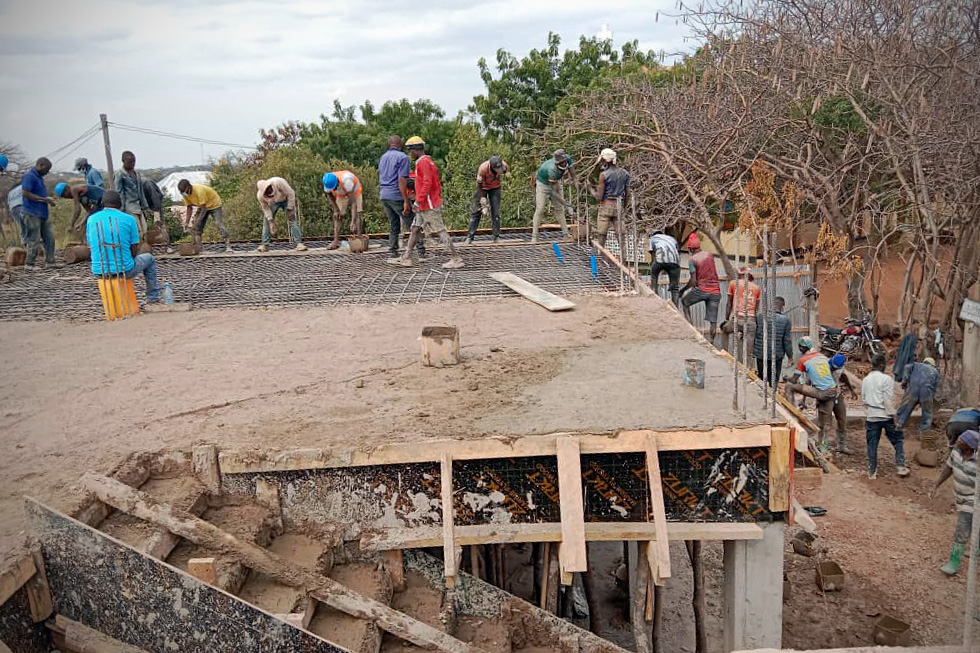
Once the first 35 columns were in place and fully cured, the carpentry work for the formwork of the first-floor slab followed in June. It will come as no surprise to anyone that weaving the double reinforcement meshes of the 260m² slab by hand was a long-term project.
The next major challenge was scheduled for July: mixing 40m³ of concrete and then carrying it up to the floor using a human chain and buckets to pour the concrete floor slab. In Belgium, no contractor would have wanted to take this on, but in Tanzania they have long known that with a bit of goodwill, nothing is impossible. Under the watchful eye of Sister Clara and with the help of 35 people from the village, the concrete slab was completed after two long days of work.
After four weeks of curing, the 130 wooden props could be removed and the brickwork on the ground floor could begin. In October, the construction of the 35 columns on the upper floor followed, and last month all the partition walls there were also bricked up. This week, work began on the roof structure and, with a bit of luck, there will be a roof on the new building before the end of this year!
We still need a lot of funding to complete the building (fitting the external joinery, plastering the interior and exterior walls, installing the building services, ceilings and tiling). Would you like to help us with this? You can find all the details here. Thank you so much in advance – every euro counts!
Related Articles
Discontinuation of tax certificates via Teachers Without Borders
Last week we received some disappointing news. The non-profit organisation Teachers Without Borders…
Memorial of the 10th anniversary of the death of Father Albert Bolle
On January 26, 2024, the tenth anniversary of the death of Flemish Father Albert Bolle in Tanzania was…